
Sustainability
Idea for a
Thirsty World
Turning air into a sustainable answer for global water scarcity.
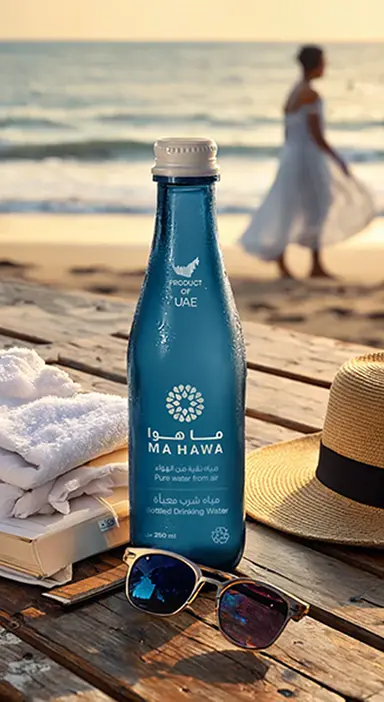
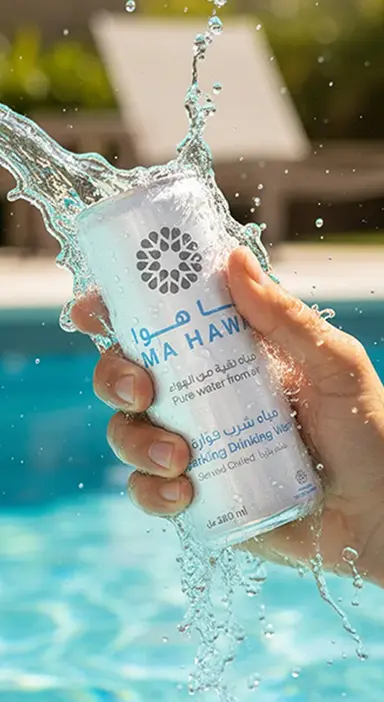
The patented air-to-water (AWG) technology used by Ma Hawa creates pure drinking water directly from atmospheric water vapour – a truly inexhaustible resource.
This is a real game-changer for the UAE, a nation with very limited freshwater resources – and for the world where about 1.8 billion people could be facing water scarcity by 2025.
Ma Hawa launched in 2023 – the year designated as the ‘Year of Sustainability’ by the UAE. The brand wholeheartedly supports the nation’s commitments to the UN’s COP28 summit.
The brand supports the national environmental priorities in two key areas:
- Conserving energy and groundwater by augmenting the UAE’s desalination and groundwater sources
- Using reusable and recyclable bottles as part of the UAE’s commitment to end plastic pollution by 2040

UAE Water security
The UAE is the second-highest water consumer per capita among GCC countries.
The UAE also has the highest water consumption rate in the world, with an average per capita consumption of 500 liters per day which is approximately 82% higher than the global average.
With water demand expected to grow by around 30% by 2030, it is crucial for the UAE government to continue its efforts towards reducing water consumption and reinforcing water security at all levels.
Health, social and environmental issues
Health, social and environmental issues - Access to clean water remains one of the world's most urgent challenges. From health risks to environmental damage, the impact is far-reaching. It's time to rethink how we source and sustain water.
2 Billion people
Drink water contaminated with feces, risking cholera, dysentery, typhoid, and polio.
80% of diseases
Are caused by poor water sanitation.
Dangerous toxins
Released into the water reservoirs inside the ground and to the ocean.
1.7 Million children
Children under the age of five die every year of illness due to shortage of clean drinking water.
50% of World Population
Will be living in water-stressed areas by 2025.
The plastic bottle disaster
Plastic bottles for water are made of polyethylene terephthalate (PET)
It takes 1/4 of a bottle of oil to produce a single water bottle
17 million barrels of oil to make one year's supply of bottled water in US alone
Single plastic 5-gallon jug = ~1 Kg of CO2 emission
Bottling water releases 2.5 million tons of carbon dioxide into the atmosphere every year.
22 BN Water bottles produced each year 91% of the bottles are NOT recycled
It takes 3 times the amount of water in a bottle of water to make it as it does to fill it.
Our Contributions to
the UN SDG
Ma Hawa Impacts 14 of the 17 Sustainable Development Goals
Water challenges
in MENA
The Middle East and North Africa is the world's most water-scarce region.
This region is home to 15 out of the 20 of the world's most water-scarce countries in the world. MENA accounts for 6% of the world's population; it receives only 2% of the world's renewable freshwater.
Water is being used as a weapon of war.
In long-term conflicts, children are on average three times more likely to die from water-related diseases than from violence. In 2017, Yemen witnessed the largest ever cholera/acute watery diarrhea epidemic in modern times which infected more than 1.3 million people of which 30% were under the age of five.
